Quick facts
Length
37–39 cm
Wingspan
About 99 cm
Weight
420–520 g (females are heavier)
Lifespan
About 4 years on average; the oldest ringed bird lived over 23 years
UK population
About 50,000 pairs
Status
Amber list (Birds of Conservation Concern)
How to recognise a tawny owl
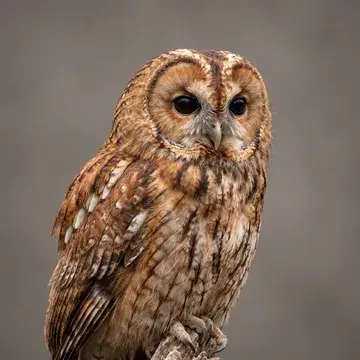
A stocky brown owl with a big round head, no ear tufts, rounded wings and large dark eyes, ringed by a pale face disc. Barn owls are paler, with a white heart-shaped face; little owls are much smaller.
Do tawny owls really go “twit-twoo”?
Not quite. The sound is a duet. The female gives a sharp “ke-wick” (the “twit”), and the male replies with a long, wavering “hoo, hu-hooo” (the “twoo”). The calls are loudest in autumn, when young owls are looking for territories of their own, and in late winter, before breeding.
Where do tawny owls live?
Woodland, farmland with old trees, parks, large gardens and churchyards across Britain. They are absent from Ireland and the Isle of Man. By day they roost hidden in trees, often close to the trunk or in ivy.
What do tawny owls eat?
Mostly small mammals such as voles and wood mice, caught by dropping from a perch. They also take small birds, frogs, earthworms and beetles. They cough up the bones and fur they can't digest as grey pellets.
When do they breed?
Tawny owls nest early. Eggs are usually laid in March, typically 2–3 of them, in a tree hole or a nest box. The young often leave the nest before they can fly properly and clamber about in branches as “branchers”, while the parents keep feeding them.
Signs to look for
- Pellets: grey, furry pellets packed with tiny bones, under a favourite roost tree
- Whitewash: white droppings down a trunk or on the ground beneath
- Mobbing: small birds scolding loudly in one spot by day can mean an owl is roosting there
Its link to the badger
Both are night hunters of the same woods. Badger watchers often hear tawny owls calling as badgers come out of the sett at dusk. Both eat earthworms and beetles, but the owl relies far more on voles and mice. What do badgers eat?
How you can help
- Keep old trees with holes, and put up a tawny owl nest box in a large garden or woodland
- A fluffy owlet on the ground is usually fine: its parents are nearby. Only move it if it's in danger, and then just onto a low branch
- Drive carefully at night along wooded roads
- Report injured owls to the RSPCA on 0300 1234 999