
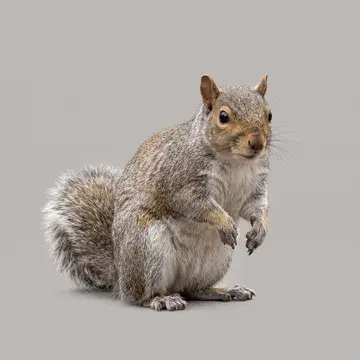
Grey squirrel facts
Length
24–28 cm, plus a 19–24 cm tail
Weight
400–650 g
Lifespan
Usually 2–5 years; up to about 9
Diet
Acorns, nuts, beech mast, bulbs and bark
Young born
Feb–Apr and Jul–Nov, 2–4 kits
Status
Invasive non-native; about 2.7 million in Britain
How to recognise a grey squirrel
Look for a silver-grey coat, a brownish face and feet, and a pale underside. Some greys have a gingery tinge, so don't go by colour alone. Compared with the red squirrel, greys are bigger, with smaller ears that never have tufts. Grey and red squirrel dreys look the same, so a nest on its own won't tell you whose it is.
Where do grey squirrels live?
In woodland, parks and gardens. The Victorians brought grey squirrels from North America, and the first wild population was recorded in 1876. Greys have since replaced red squirrels across almost all of England and Wales.
What do grey squirrels eat?
Acorns, beech mast, nuts, flowers, bulbs, bark and shoots. Grey squirrels bury spare food for the winter, often near the base of trees.
When are baby grey squirrels born?
Grey squirrels usually have two litters a year: the first from February to April and the second from July to November. Each litter has 2 to 4 young, called kits or kittens, born in a drey of twigs and leaves high in a tree. They are weaned at 8 to 10 weeks.
Signs to look for
- Nuts: hazelnut shells split cleanly in half
- Cones: pine cones chewed down to look like apple cores
- Dreys: football-sized nests at least 6 m up, close to the trunk
- Bark and calls: stripped bark on young trees, and a scolding "chuk chuk" call
Its link to the badger
Grey squirrels and badgers both feed on acorns and nuts in broadleaved woods in autumn, though squirrels gather them by day and badgers by night. Greys have also changed the badger's woods in a bigger way: across most of England and Wales, they have replaced the native red squirrel.
How you can help
- Never release a grey squirrel into the wild. Greys are an invasive non-native species, and releasing one is against the law.
- Support your local red squirrel group. Greys carry squirrelpox, which doesn't harm them but kills red squirrels.
- Record red and grey squirrel sightings with the Mammal Society's Mammal Mapper app.